
· News · 2 min read
China's First Clinical Triage Embodied Intelligent Robot Deployed at Shanghai Sixth People's Hospital
Adora Robot team provides underlying software and hardware technical support
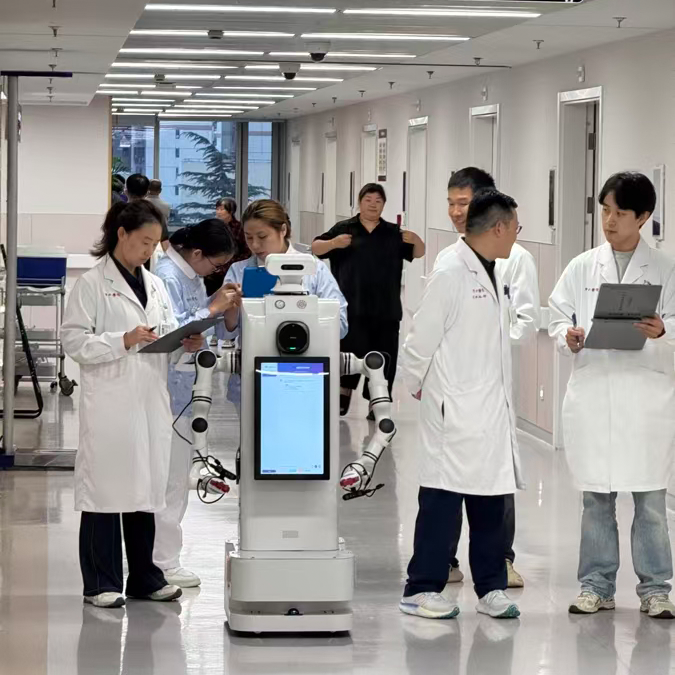
Recently, a wheeled humanoid robot debuted at the National Orthopedic Medical Center of Shanghai Sixth People’s Hospital, entering the trial phase. It is China’s first embodied intelligent robot for clinical diagnosis and treatment, developed by Professor Zhang Tao’s team from Tsinghua University’s Department of Automation, with underlying software and hardware technical support provided by the Adora Robot team. In the orthopedics department of Shanghai Sixth Hospital, it provides pre-diagnosis services for patients waiting to see doctors, while completing some examination items such as gait and muscle strength tests, then performs multimodal analysis of the consultation and examination information to form auxiliary diagnosis suggestions and send them to doctors.
Technological Innovation Driving Embodied Intelligence into Hospitals
“This robot is a general intelligent device built by the Tsinghua team for hospitals, capable of meeting different clinical needs,” said Gao Xiao, CEO of Qingkan Intelligence, pointing to the wheeled humanoid robot beside him at the National Orthopedic Medical Center of Shanghai Sixth Hospital. It stands about 1.6 meters tall, with a screen on its upper body for displaying diagnostic information, and a wheeled chassis on its lower body suitable for moving around the hospital. Its robotic arm can be combined with different medical equipment to complete auxiliary treatment work. Its algorithms and sensors can be configured according to different clinical needs, providing strong scalability.
Wheeled Humanoid Robot “On Duty” at Shanghai Sixth Hospital National Orthopedic Medical Center
After years of accumulation, Professor Zhang Tao’s team developed the “Intelligent Agent-Driven Multi-Equipment Medical Integration Technology” framework. It breaks through the limitations of traditional AI-only analysis frameworks, innovatively integrating control algorithms with artificial intelligence - using control algorithms to drive hardware equipment and using AI for precise analysis and decision support, achieving the implementation of embodied intelligence in real hospital scenarios.
Currently, trial results at Shanghai Sixth Hospital’s orthopedics department show that the robot takes 5-8 minutes to pre-diagnose a patient, theoretically capable of completing pre-diagnosis for more than 60 patients in an 8-hour day. For doctors, the robot assistant can improve diagnosis and treatment efficiency and reduce their workload; for patients, the robot assistant increases the dimensions of clinical evaluation, ensuring diagnosis quality while providing a better experience.