
· News · 5 min read
GOSIM2025 Adora Robot Hackathon Highlights - Congratulations to 15 Winning Teams!
Celebrating the successful GOSIM2025 Adora Robot Hackathon
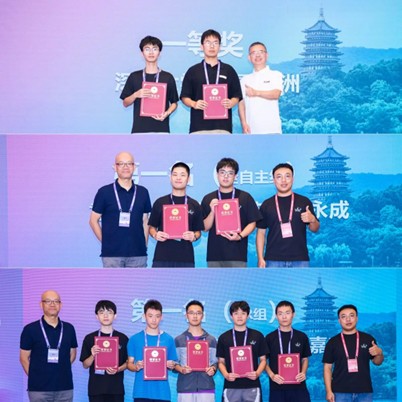
On the afternoon of September 14th, after 48 hours of intense competition, 15 teams emerged victorious in the GOSIM Adora Robot Hackathon! They stood out with their unique creativity, solid technical skills, and excellent presentations. Congratulations to all winning teams!
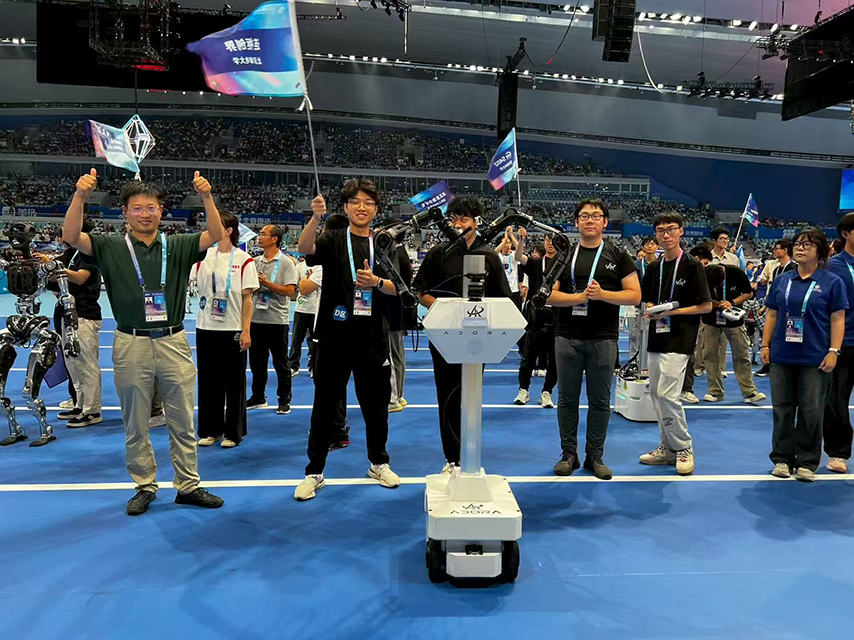
During the afternoon workshop, participating teams took turns presenting their creative concepts and technical implementations to the judges and audience. From clever embodied AI algorithm designs to refined robot interaction features, every project demonstrated exceptional innovation and practical capabilities. The venue was filled with applause and cheers, with frequent interactions creating an atmosphere of creative collision that inspired every developer present.
Xinxun Intelligence, as the official hardware sponsor, provided hardware, prizes, and technical support for this Adora Robot Hackathon. Under the guidance of the GOSIM organizing committee, we are proud to have witnessed the rapid growth of each participating team and seen everyone’s tremendous enthusiasm for embodied intelligence. Every project entry was filled with unlimited creativity and imagination. This is exactly the direction we have been pushing: getting more and more developers involved in the DORA open-source community and growing together with the community!
We provided nearly one million yuan worth of robot hardware equipment:
- 2 sets of Adora 2 Max robots
- 3 sets of Adora 2 Pro robots
- 10 sets of Lerobot robot kits
For the 15 outstanding teams selected, we also provided cash prizes:
- VR Teleoperated Robot Medication Sorting Competition: First, second, third, and merit prizes: 1000, 500, 200, 100 yuan respectively
- Autonomous Robot Medication Sorting Competition: First, second, third, and merit prizes: 1000, 500, 200, 100 yuan respectively
- Lerobot Hackathon Competition: First, second, third, and merit prizes: 1000, 500, 200, 100 yuan respectively
Selecting the top 15 winning teams was extremely difficult - every participating team worked around the clock for 48 hours, and their focus and final works impressed us greatly, giving us more confidence in organizing future hackathons.
In the VR Teleoperated Robot Medication Sorting Competition, the VR teleoperation solution proved more efficient than exoskeleton and master-slave arm approaches, with better operational experience, and has gradually become the mainstream teleoperation method applicable to embodied AI data collection scenarios. However, the challenges in the actual sorting competition were more demanding than expected: participants not only faced the “black box” interface development difficulties due to limited resources for the closed-source Songling robotic arm, but also discovered that the VR headset, which should have provided an immersive experience, could not display real-time video from the robot site, completely disabling the core teleoperation vision - a problem that couldn’t be fully solved in the short term. Facing these challenges, team members demonstrated exceptional adaptability. Shanghai Jiao Tong University Team 1 won first place in the VR Teleoperated Robot Medication Sorting Competition!
The key challenge of the Autonomous Robot Medication Sorting Competition was that the robot needed to autonomously parse paper prescription information and complete high-precision medication sorting - both interpreting unstructured paper prescriptions through visual recognition and quickly locating target medications in cluttered pharmacy shelves. The Chongqing University of Posts and Telecommunications team innovatively employed a self-developed multimodal large language model, successfully achieving cross-modal association between paper text and 3D space. The system ran completely autonomously with zero human intervention, winning first place with an absolute advantage.
The Lerobot Hackathon Competition challenged participants to explore optimal data collection strategies for complex multi-target, multi-step grasping tasks within limited time and train imitation learning models with strong generalization capabilities. Shenzhen University Team won the Special Prize in the Lerobot Hackathon Competition!
Other participating teams from the University of Science and Technology of China, Beijing Institute of Technology, Nankai University, Chinese Academy of Sciences, Beijing Jiaotong University, and other institutions received first, second, and third prizes. Congratulations to them!
About Xinxun Intelligence
Xinxun Intelligence is the ecosystem company of the Dora-rs open-source robot middleware project. Dora-rs (Dataflow Oriented Robotics Architecture) is an advanced edge-cloud collaborative autonomous driving and robot middleware framework, deeply adapted to domestic Ascend AI chips and OpenHarmony system, providing a high-performance dataflow computing platform.
Dora-rs innovatively implements the AI agent RoboBrain architecture, fully supporting the “brain-cerebellum” collaborative system (the “brain” handles cloud-based intelligent decision-making and continuous learning, while the “cerebellum” enables local real-time control and rapid response). This architecture significantly enhances robots’ autonomous decision-making capabilities and response speed in complex scenarios.
The Xinxun Intelligence core team comes from well-known domestic and international institutions, maintaining deep cooperation with universities such as Tsinghua University, Beijing Institute of Technology, and Chongqing University of Posts and Telecommunications, as well as institutions like the Beijing Academy of Artificial Intelligence and Shenzhen Kaihong (OpenHarmony core ecosystem enterprise). The company focuses on embodied intelligent robot development based on the Dora-rs middleware community, with products achieving deep adaptation to the OpenHarmony system and fully leveraging the NPU acceleration capabilities of Ascend chips.
Currently, the company has launched two product series: single-arm four-wheeled mobile robots and dual-arm embodied intelligent robots, widely used in scientific research and education, campus security, industrial automation, and smart home applications.
For any business inquiries, please contact us at nhuang@dora-rs.org.